Three coffees and a founder who’s making the women behind every cup impossible to overlook.
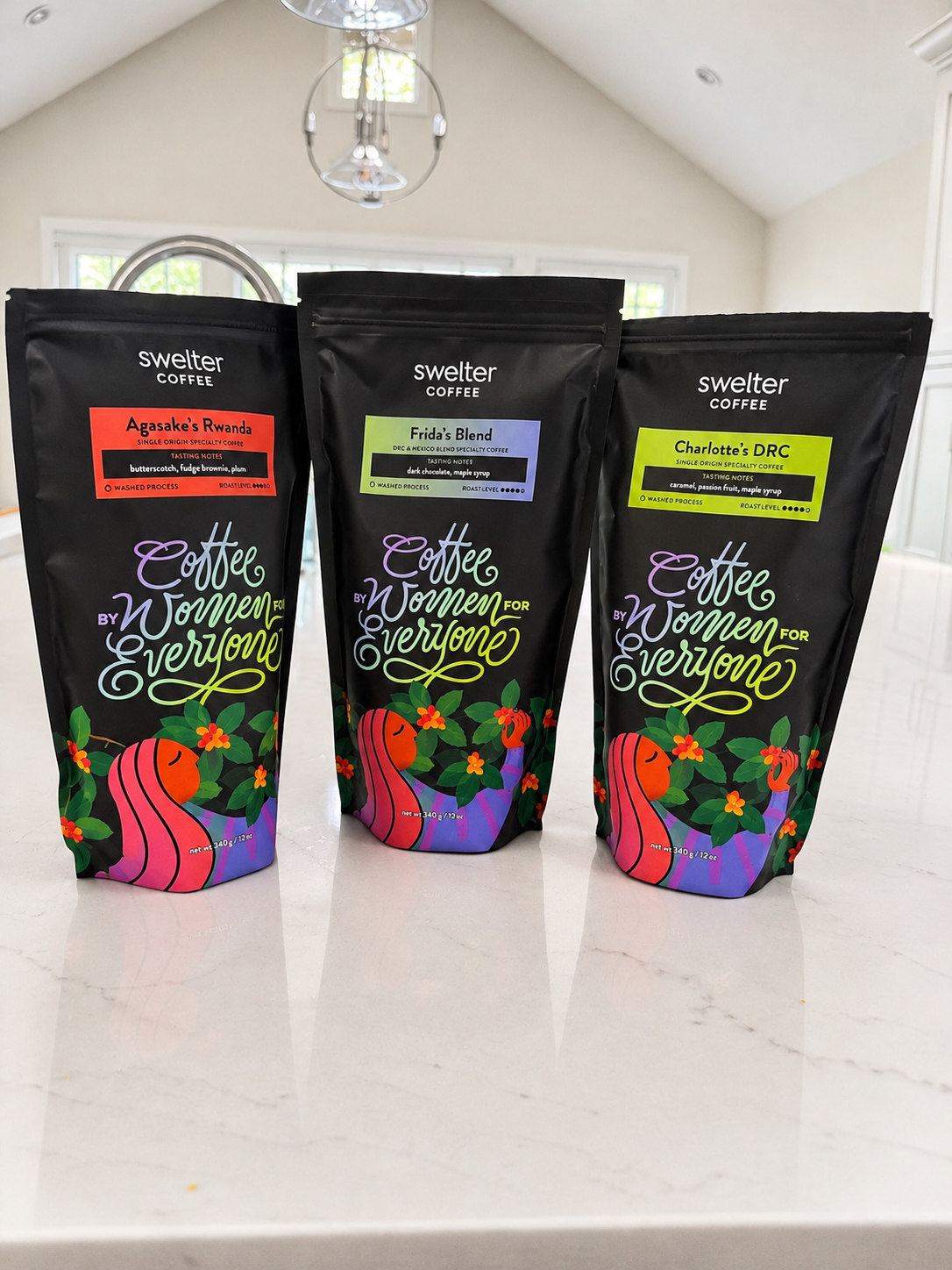
Coffee is one of the few things my husband and I both take seriously, although we don’t necessarily agree on which roast belongs in our kitchen. Recently, we’ve been drinking three coffees from Swelter Coffee, a women-focused specialty coffee brand founded by Stephanie Welter-Krause.
My favorites are Charlotte’s DRC and Frida’s Blend. My husband prefers Agasake’s Rwanda. And while we have different preferences, what makes Swelter particularly interesting is the story behind the beans.

Three Coffees, Three Distinct Personalities
Charlotte’s DRC is a single-origin coffee from the Democratic Republic of the Congo, named after a woman in the producing cooperative. Its tasting notes include caramel, passion fruit, and maple syrup. But I also find it has a clean finish. It’s one of my favorites because I appreciate coffees with a little complexity. I don’t always want something that tastes exactly like the coffee I had yesterday.
Frida’s Blend is my other favorite. It’s a darker, more comforting blend with tasting notes of dark chocolate and maple syrup. The coffee combines beans from Mexico’s Bella Vista Cooperative, which accounts for 70% of the blend, with 30% from Congo.
Something about that combination of richness and character appeals to me. It’s the kind of coffee I gravitate toward when I want something familiar but still interesting.
My husband, meanwhile, prefers Agasake’s Rwanda, a single-origin coffee with tasting notes of butterscotch, fudge brownie, and grapefruit. Of the three, it’s his favorite, especially for espresso. And I like that we’ve found a coffee brand that accommodates our different tastes without compromising on its larger philosophy.
From Roasting Coffee at Home to Building a Brand
Swelter began long before its official launch in 2020. Around 2013, Stephanie started experimenting with roasting coffee in her home oven in Oakland. What began as curiosity turned into a passion, and soon she was roasting for friends and colleagues at the Berkeley graphic design studio where she worked. Her professional background eventually shaped the business's direction.
After attending a talk by environmentalist Paul Hawken about Project Drawdown, she became interested in the connection between gender equity and climate solutions. She began thinking about the women who grow and process much of the world’s coffee, many of whom receive little recognition or access to the economic opportunities available to men. That realization became the foundation for Swelter.
Rather than simply selling specialty coffee, she wanted to build a company that placed women producers at the center of the conversation.
The Women Behind the Beans
One of Swelter’s earliest sourcing relationships was with Rosalba Ci Fuentez of Mayan Harvest, who helps bring coffee from women producers in Chiapas, Mexico, to the United States. Her work helped make Frida’s Blend possible.
The Congolese component of the blend comes through another sourcing relationship that supports women coffee growers and creates economic opportunities in communities affected by conflict. Agasake’s Rwanda has its own story.
Swelter works with sourcing partners who share its commitment to supporting women coffee producers and strengthening their communities. These relationships go beyond purchasing beans and are intended to support economic opportunities and stronger, more sustainable coffee-growing communities.
What I find particularly meaningful is that Swelter isn’t treating these relationships as a seasonal marketing campaign. The company aims to work with the same producers year after year, building long-term partnerships whenever possible.
Why This Coffee Feels Different
I appreciate brands with a clear point of view, especially when that perspective shapes how the business actually operates. Swelter selects coffees based on quality, traceability, and relationships with women producers. The company looks for specialty-grade beans and sourcing partners who share its commitment to transparency.
The founder’s philosophy is straightforward: the coffee should taste wonderful first, but the people who produce it should also receive recognition and fair economic opportunities.
That’s an approach I can appreciate. And in our household, the coffee itself has certainly given us something to talk about. I reach for Charlotte’s DRC or Frida’s Blend. My husband reaches for Agasake’s Rwanda. Different coffees, same company, and a much more interesting story behind our morning cups.
Explore Swelter Coffee: Swelter Coffee