Meet Alex Payetta’s Bedside and Deskside Journals, an appealing way to organize your thoughts, protect your time, and remember you have a life outside your inbox.
You know that moment when you’re finally in bed, the lights are off, and your brain decides it’s the perfect time to remember an email you forgot to send three days ago? Or when you sit down at your desk with a perfectly reasonable to-do list, only to discover that six hours have passed and you’ve somehow accomplished everything except the thing you actually needed to do?
Welcome to modern adulthood. Apparently, we’re all running very sophisticated businesses, careers, and households on a mental operating system that could use a software update. That’s where Alex Payetta comes in.
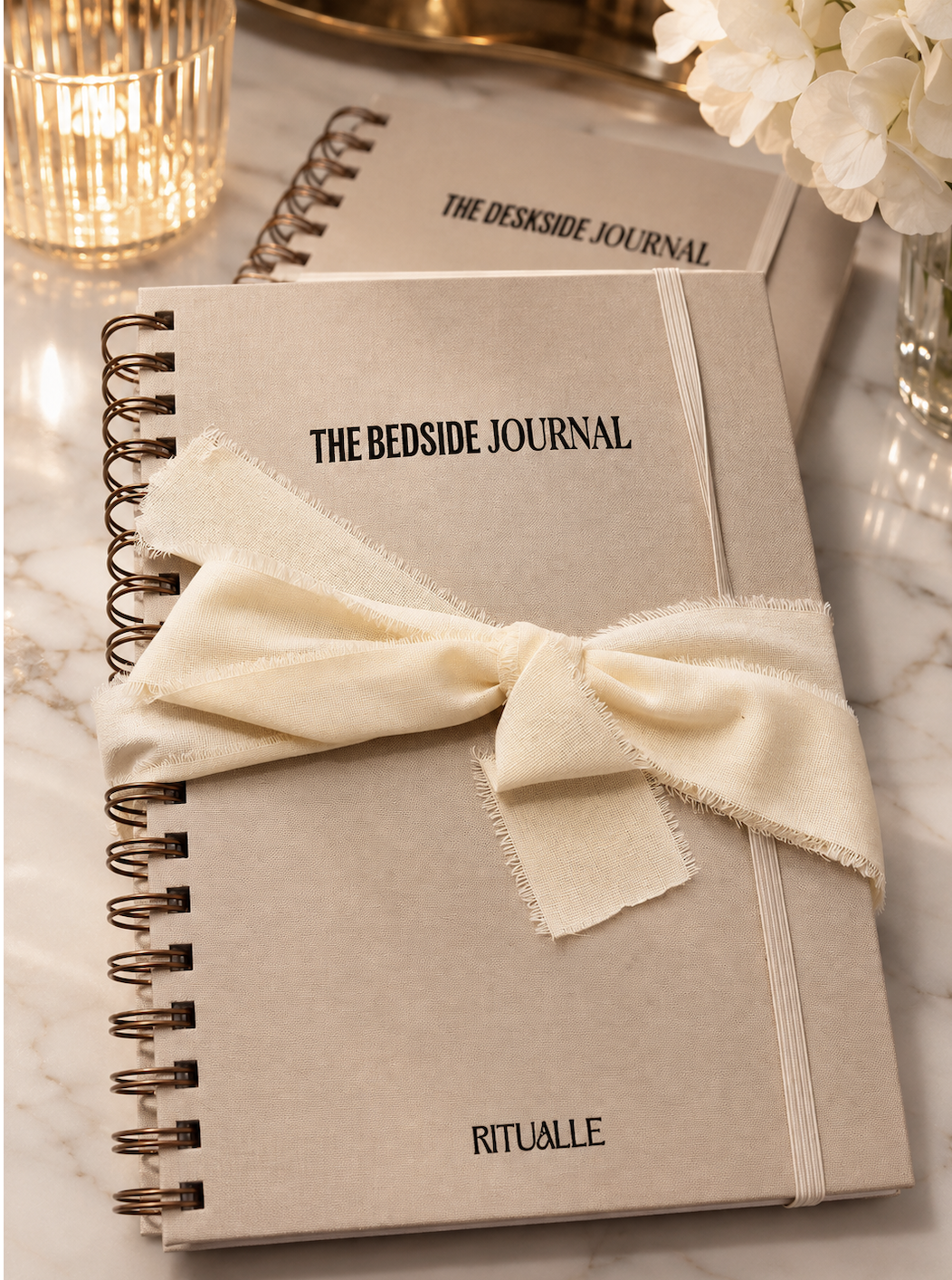
The entrepreneur and operations consultant has created two thoughtfully designed journals under her Ritualle brand: the Bedside Journal and the Deskside Journal. One is intended to help you begin and end your day with a little more intention. The other helps you get through your workday without carrying every unfinished task into dinner.
And unlike the productivity systems that require seventeen color-coded categories, three apps, and a Sunday afternoon dedicated entirely to planning, these journals ask for something considerably more manageable: a few minutes of your attention.
First, Let’s Talk About Your Bedside Table
The Bedside Journal is built around a simple idea: how you begin and end your day deserves more consideration than whatever happens to be waiting on your phone.
The $49 journal provides 12 weeks of guided morning and evening prompts, with approximately five minutes of writing at each end of the day.

In the morning, the prompts encourage you to check in with yourself, identify how you’re feeling, and think about how you want to approach the hours ahead. At night, the emphasis shifts to reflection, acknowledging what happened, and giving yourself a chance to close the day mentally.
It’s a refreshingly practical alternative to waking up and immediately checking whether someone has emailed you something irritating.
The journal is organized around three concepts: grounding yourself, shifting your perspective, and directing your attention. It also includes weekly reflection pages, so you can look back at what’s working rather than move through the weeks on autopilot.
The format is undated, which is particularly useful for those of us who bought beautiful journals in January, wrote in them enthusiastically for four days, and rediscovered them in September.
There is no missed-date guilt here.
And for anyone who doesn’t particularly enjoy writing, the journal also comes with an audio version of the prompts. You can listen and reflect without necessarily putting pen to paper.
It’s a small detail, but an important one: the routine is designed to fit into your life, not become another obligation.
Now, About That Desk Full of Unfinished Business
If the Bedside Journal is about how you feel, the Deskside Journal is about what you do with your attention. And frankly, attention has become a rather expensive commodity.
Between emails, messages, meetings, deadlines, and the mysterious tasks that appear on your calendar without your permission, it’s remarkably easy to spend an entire workday reacting to other people’s priorities.
The $49 Deskside Journal offers a different approach.
Its 12-week format centers on about five minutes of planning at the start of the workday and another five minutes of reflection before you finish.
The morning prompts help you identify your available energy and determine which priorities actually deserve your attention. Rather than treating every task as equally urgent, the idea is to decide what matters before your inbox does.
Throughout the day, the emphasis is on protecting periods of focused work. At the end, the journal encourages you to document unfinished tasks and prepare for the next day.
That final step might be the most appealing part.
Because there’s a particular kind of exhaustion that comes from finishing work physically while continuing to work mentally.
You close your laptop, but you’re still rewriting an email in your head. You’re making dinner and trying to entertain a preschooler, while mentally reorganizing tomorrow’s schedule. You’re technically watching television, but part of your brain is still in a meeting that ended at 2:30.
It won’t make your responsibilities disappear, but a consistent place to capture them may make it easier to stop carrying everything around in your head.
The Clever Part Is That They Work Together
What makes Payetta’s approach interesting is that the two journals address different parts of the same problem. The Bedside Journal focuses on your personal state of mind. The Deskside Journal focuses on how you direct your attention professionally. One asks how you want to feel and show up in your life. The other asks what deserves your energy while you’re working. Together, they create a rhythm that moves from personal intention to professional focus and back again.
You don’t have to use both. Each journal functions independently. But the pairing makes sense, especially for entrepreneurs and professionals whose workdays don’t always have clearly defined boundaries.
And something is appealing about keeping these two parts of life separate without pretending they don’t influence each other.
A difficult workday can follow you home. A restless night can affect your concentration the following morning. The journals acknowledge that connection while giving each part of your day its own space.
They’re Also Pretty
Of course, we should discuss the design.
Both journals come in a 6-by-9-inch linen hardcover format with a lay-flat binding and elastic closure. They’re substantial enough to feel like proper desk or bedside accessories without becoming another oversized planner you have to carry around.
The Bedside Journal contains 152 pages, while the Deskside Journal contains 188. Both are undated, with guided daily entries and weekly reflections.
And yes, there’s something satisfying about a beautifully designed notebook that looks at home beside a coffee cup, a reading lamp, or an otherwise chaotic collection of office supplies.
Aesthetics won’t solve your scheduling problems, but they certainly don’t hurt when you’re trying to establish a new habit.
Do You Really Need Another Journal?
Possibly not. If you already have a journaling routine you enjoy and a planning system that works, there’s no reason to abandon either.
But if you’ve repeatedly tried to become a morning-journaling person, purchased elaborate planners that never quite fit your schedule, or found yourself thinking about work long after the workday ends, Payetta’s approach is worth exploring. Its appeal is the relatively small commitment.
You’re not being asked to redesign your entire life over a weekend. You’re being invited to spend a few minutes paying attention to what you’re thinking, what you’re doing, and whether the two are working together.
The journals are designed around ideas drawn from attention, habit formation, and reflection, though their effectiveness will naturally depend on how consistently you use them. They’re organizational tools, not a guaranteed solution to stress or sleep difficulties.
Still, the underlying proposition is appealing: perhaps getting more organized doesn’t always require doing more. Sometimes it requires giving yourself a defined moment to decide what matters.
A More Focused Day
There’s no shortage of products promising to make us more productive, more focused, or more successful. Most assume we have unlimited energy to devote to becoming better versions of ourselves.
What makes the Bedside and Deskside Journals interesting is that they start with a more realistic assumption: people are busy, their attention is fragmented, and any new routine has to be simple enough to survive an ordinary Tuesday.
You don’t need to become a completely different person to use them. You don’t even need to have particularly beautiful handwriting.
You need a few minutes, a pen, and a willingness to stop letting every thought live rent-free in your head.
When you think about it, that sounds like a rather lovely way to begin and end the day.
The Details
The Bedside Journal and Deskside Journal are available individually for $49 each. The two-journal set is offered for $89, a $9 savings compared with purchasing them separately.
Both journals include 12 weeks of guided entries, weekly reflection prompts, audio resources, and a printable habit tracker. The duo also makes a great holiday gift this year.