Jewelry should tell a story with Fine Jeweler, Liza Michelle Sexton
Liza Michelle Sexton is the founder and designer behind Liza Michelle Jewelry, a Cleveland-based fine jewelry studio specializing in custom engagement rings, heirloom redesigns, and thoughtfully designed ready-to-wear collections. A trained metalsmith with a background in fine arts, she has spent more than 13 years building a business rooted in craftsmanship, ethical sourcing, and deeply personal client relationships.
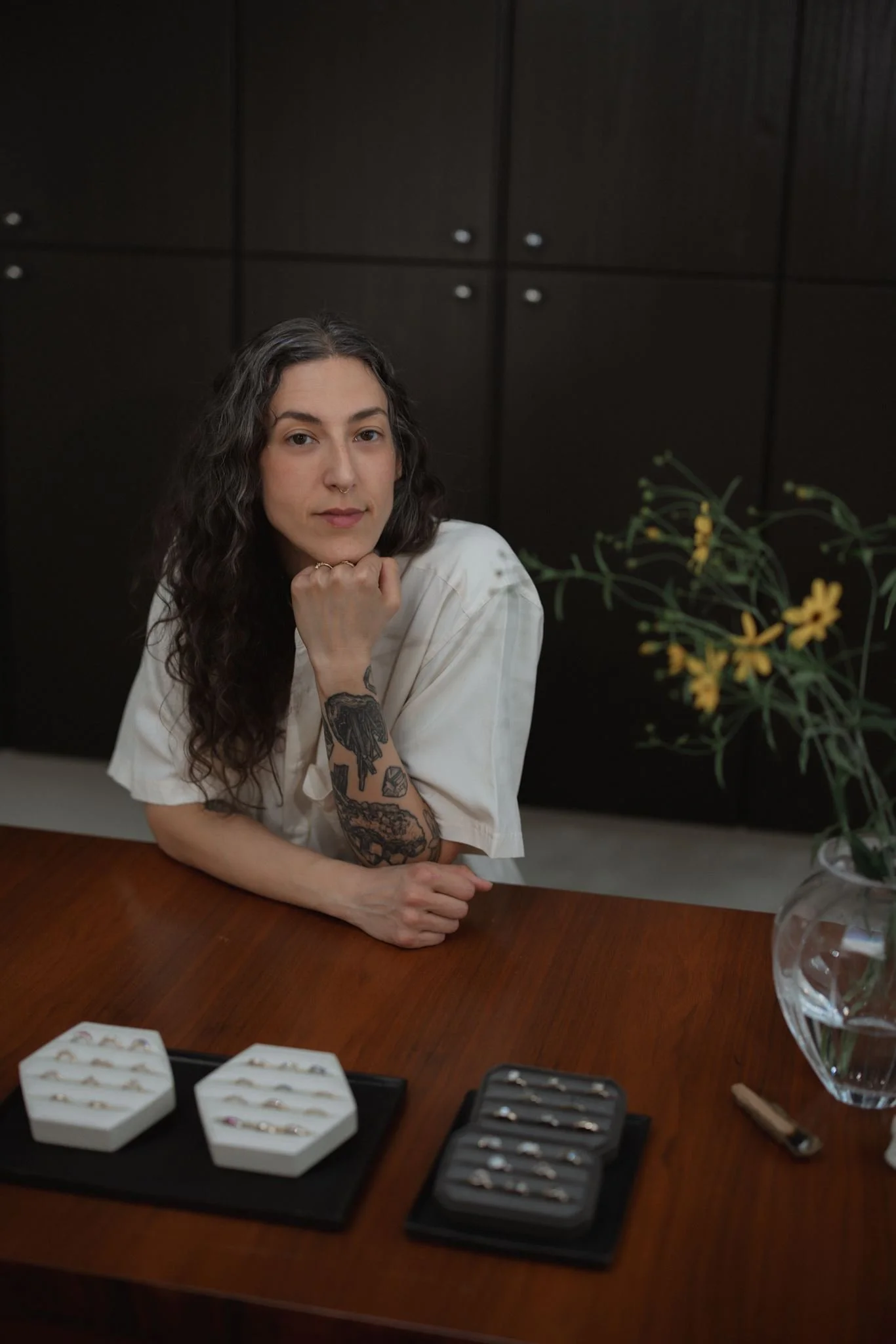
After beginning her career on the national craft show circuit, Liza grew her studio into a destination for bespoke jewelry by blending traditional goldsmithing with a collaborative design process. Today, she works primarily in recycled gold and responsibly sourced gemstones, creating pieces that celebrate life's milestones while balancing beauty, durability, and everyday wearability. Her philosophy is simple: jewelry should tell a story, feel effortless to wear, and be made to last for generations.
Take me to the moment commodity pricing forced your hand. What specifically moved, when, and what did it do to the economics of a piece you were already selling?
By the end of 2025, I was repricing jewelry almost as fast as I could photograph and upload it. Gold had climbed steadily, but silver, the metal that anchored our entry-level collections, rose so quickly that pieces we'd designed to be accessible suddenly weren’t. We’d been seeing an upward trend in gold pricing since early 2024, but the end of 2025 into this year really saw the most astronomical spikes, bringing silver along with it. Silver has always been the stalwart offering for Liza Michelle Jewelry, providing a lower-priced option in contrast to our fine jewelry collections and serving as an entry point for new customers. With a total increase of 279% in 2025 and a huge 70% leap in early 2026, silver pricing effectively rendered lower-priced collections no longer viable. Gold prices rose as well- though less dramatically, no less significantly. From 2025, into 2026 we saw a 65% increase in gold pricing, rising 5% in a single day in January 2026 to its peak price of $5600/oz.
In 2025, with the rising gold prices in mind, I launched two new collections both focused on sterling silver as the main material to help bolster sales where we lost our lower/midrange gold buyers and to provide a larger pool of offerings to entry level clients. As soon as the collections launched in October ’25 I had to rapidly re-price, and then re-price again, as silver rose at a historically fast rate. The same was true for our gold collections. As quickly as I priced at a new “normal” the market rose and I had to respond or lose money. We ultimately shifted from a single pricing model to collection-specific margins. Where we typically would see 70% margins on silver ready-to-wear collections, we had to shift to 60%-65% to help bridge the gap between perceived value and the economics of the piece, and even lower to 55% for some of our gold pieces.
You had a few ways to respond: raise prices, change the policy, or change the line itself. Which did you choose first, and what made you rule out the others?
At first in response to rising commodity prices, I adjusted our pricing; however, I quickly saw that with our current model our prices were not inline with what the market would support. I had to quickly assess what pieces were worth keeping, and how to market them in a way that allowed customers to see the investment in the piece. We leaned into sculptural, highly distinctive pieces rather than simpler designs because they communicated value beyond the raw cost of the metal. Within our gold offerings, we saw that people with the intent to invest in custom gold pieces were still buying, however, gold purchases of a more spontaneous nature or not linked with a large life event had slowed.
I never wanted to sacrifice LMJ’s ethos--a dedication to what I call delicate heft--a commitment to durable, comfortable pieces that still maintained their lightness and wearability. We kept our minimum widths and thicknesses in our bands and chains and never compromised on plating our pieces. I recognized that the quality and design that LMJ has been known for these 13+ years in business is what would carry us through the turbulence. A commitment to quality, first, and storytelling would allow us to help our customers prioritize purchases that still aligned with their values, and felt like a good investment.
What did that decision cost you? Name the customers, the margin, or the pieces you lost; the honest number makes this worth reading.
Two moments immediately come to mind, losing a custom client over pricing. A couple who designed their engagement ring with me were priced out of wedding bands, which is always disappointing for both parties. Those are the moments that stick with me, not because we lost a sale, but because we lost the opportunity to finish a story we'd already started together. I can also recall a client looking for a bespoke engagement ring that was priced out both for the build as well as the diamond they were hoping to purchase. In 2025 LMJ saw a 32% drop in gross profit from the previous year, directly correlated to rising prices and a lack of new clientele with the changing economic landscape in the US.
However, despite 2025’s disappointing showing, it was a prime year for incubating and building, migrating our website from Squarespace to Shopify, entering into strategic partnerships with vendors such as Misfit Diamonds, and laying the foundation for our continued growth in 2026. So far this year, we’ve seen a 109% increase in sales compared to the same period last year. I believe that by not losing ourselves in the turbulence of economic shifts and by maintaining our marketing message and dedication to quality, we were able to weather the initial shock of the price increase. As clients' understanding of pricing and reprioritization of purchasing have stabilized,, we’ve seen a resurgence of custom projects and, hopefully,, with our PR and marketing efforts this year, a rise in ready-to-wear sales as well.
You mentioned you're building out your marketing and PR presence right now. What has been hardest about getting your work in front of the right people?
At the beginning of this year I sought a PR professional to help propel LMJ into a more national marketplace. After 13 years of a near white-knuckle grip on most operations, and mainly relying on referral-based marketing, I recognized the biggest hole in our system was our ability to get in front of more people. I knew that we had a great product, that our process for working with clients was tested and proven successful, and that our marketing storytelling was top-notch. The hardest part hasn't been convincing clients who find us; it's helping the right people discover us in the first place. The jewelry industry is incredibly saturated, and communicating what sets LMJ apart without sacrificing authenticity is a constant challenge. PR is a long game. I’ve been working for the past 6 months to build a foundation that will serve us in perpetuity: systems and a new way of thinking about marketing that will ultimately get us in front of a lot more people. Ours is an industry built on feelings; we deal with clients' biggest moments, like engagements, weddings, parenthood, and anniversaries—all types of milestones.
LMJ is really great at telling those stories, capturing those moments in jewelry, and meeting people where they are to help them design or pick out a piece of jewelry that helps further that story. Communicating that in an effective way that feels authentic can be tricky- especially when casting a wide net. I am excited to see how our PR efforts and new marketing approach can help us reach more clientele.
You're refocusing on DTC e-commerce and creating long-term roles in sales and service. What are you building toward, and what has to be true for it to work?
My background is fine arts. I went to private art school and learned how to make conceptual art work, and to represent myself in seeking gallery shows and large commission work. I have no formal business training or MBA to fall back on. I think this origin has been both my most important quality and the biggest thing holding me back. I resisted the idea of large-scale growth, building a team, and relinquishing my control or touch on most aspects of the business for a while. This approach has definitely yielded a strong sense of identity and a clear image of who LMJ is and what we do. In the past year, however, I came to realize that my biggest strength outside of jewelry design is strategy and the craft of building this business.
Being pregnant with our first child this year, I realized that I had two paths: scale down to accommodate this growing life sustainably, limit our offerings and custom projects- effectively shrink this side of my life to accommodate our expanding family. Or, I could go big. I could leverage all that I had built so far and really commit to scaling the business. So I chose to build out the parts of the business that historically couldn’t live without me, so that I can steer the ship without being so tied to the day-to-day of ops. What had to be true for me, was to imagine the business succeeding without depending on me for every decision, to be inspired by and excited about a team who wants the same growth and opportunity and believes in what we do.
In the process, we’ve hired a client relations coordinator; our marketing coordinator has gotten a boost in responsibility as well as support from the PR professional I contracted, and our plan when I’m back from maternity leave is to hit the ground running with hiring bench jewelers to help support production with our continued exposure. It’s a delicate balance, at a delicate time. Leveraging marketing and PR, hoping that the pipeline works that will support bringing in bench jewelers to make the work, all at a time when AI and shortcuts have taken over, prices are higher across the board, and there are more options visible in more places to potential clients than ever before. Ultimately, I dream of a company run by people for other people. Our mantra has always been "Jewelry for all Humans," and scaling the business has never been about becoming bigger for its own sake—it's about serving more people without losing the humanity that built the company in the first place.