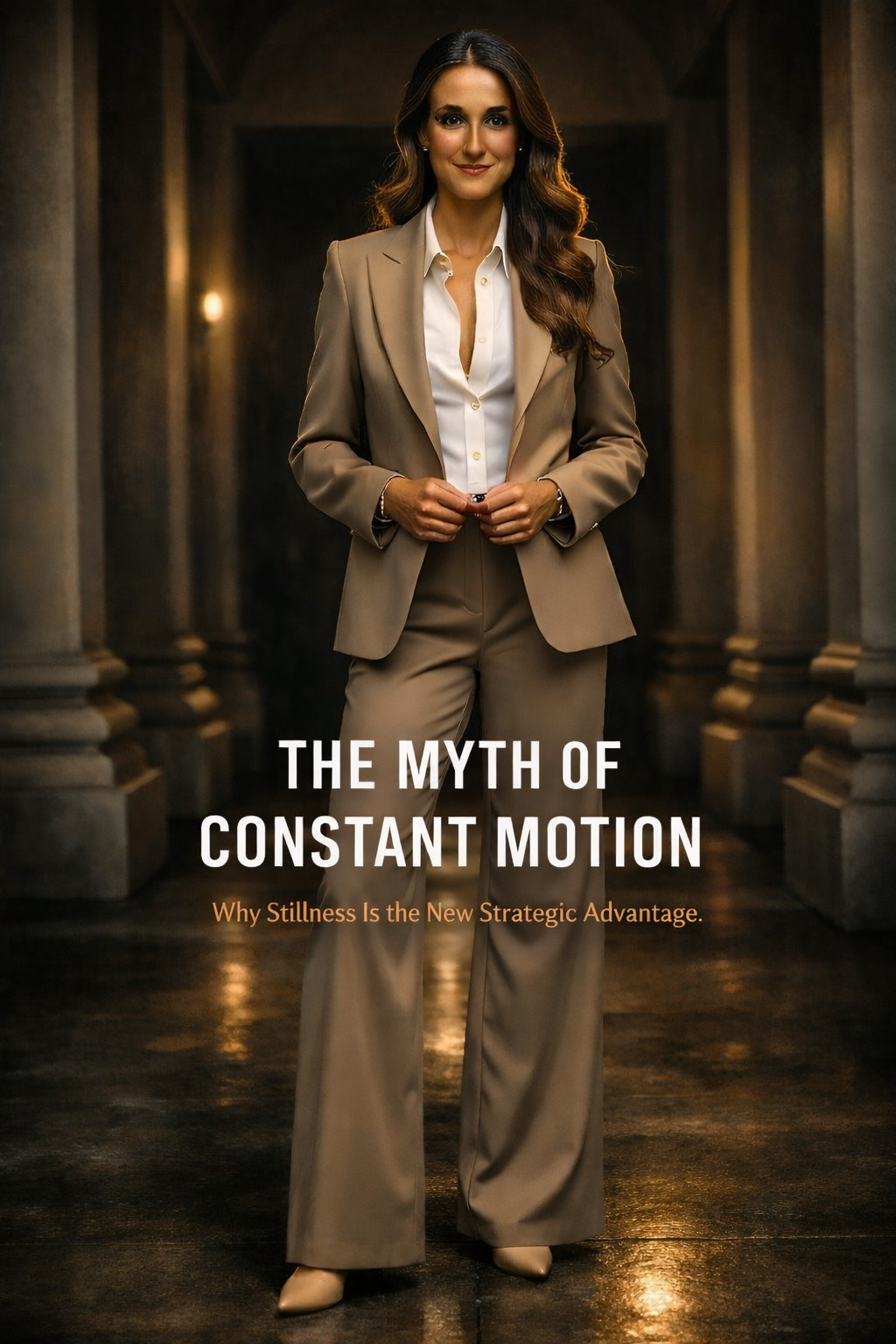
The Myth of Constant Motion: Why Stillness Is the New Strategic Advantage
There is a quiet lie we keep telling ourselves, and one another: that motion is the only proof of seriousness. We watch the feed scroll—more posts, more stories, more launches, more “behind the scenes,” more everything—and somewhere along the way we begin to believe that if we are not visibly accelerating, we are quietly failing. But the women I have watched build the most enduring things do not live in perpetual forward motion. They live in pauses that look like nothing is happening. They choose stillness, not because they are tired, but because they understand that clarity cannot be rushed.
Stillness is not laziness. It is a deliberate structure. When the pace becomes compulsive, everything starts to blur. Decisions turn reactive. Positioning becomes diluted. Visibility becomes volume. Culture becomes exhaustion. The business begins to mirror the leader’s internal rhythm instead of the intention she originally set. The founders who know last something most people miss: the most powerful moves often require the least visible effort. They step back—not to stop working, but to see clearly. They ask questions that do not need instant answers: Is this still true to what we are? Does this next thing return more than it takes? Are we growing in a way that keeps the core intact? These are not soft questions. They are the structural ones. They separate expansion that strengthens from expansion that quietly weakens.
Visibility especially rewards restraint. The presence that lingers is rarely the loudest or the most frequent. It is the one that arrives only when it has something precise to say. A founder who speaks sparingly but with weight creates anticipation. The audience leans in because they know the next word will matter. Silence between statements is not empty—it is trust. Positioning works the same way. A brand that tries to be everything to everyone ends up whispering to no one. The women who win in the long term are ruthless about what they refuse to be. They draw clean edges and defend them. A well-timed “no” is often more powerful than another “yes.”
Even growth shows its real shape in stillness. Rapid scaling can hide misalignments—unclear ownership, inconsistent standards, energy leaks that compound until they become visible fractures. The pause lets those things surface before they become terminal. It gives time to reinforce what is already strong and release what is quietly draining. This is not about doing less for aesthetic reasons. It is about doing what matters, with full attention, and trusting that considered action compounds more powerfully than compulsive motion.
The current environment still rewards speed—until it stops. The moment pressure arrives (economic tightening, audience fatigue, personal burnout), the businesses built on constant motion are the first to crack. The ones built on deliberate stillness—clarity under pressure, visibility earned through restraint, growth that respects finite energy—are the ones that remain standing. So the next time the pressure rises to do more, faster, louder—pause. Not to quit. But to see. Because the future does not belong to the busiest. It belongs to the most deliberate.
If this lands somewhere true for you, explore the deeper frameworks we use to help women leading established businesses turn stillness into leverage: visibility that reduces effort, positioning that endures, growth that preserves what matters most. Begin here.